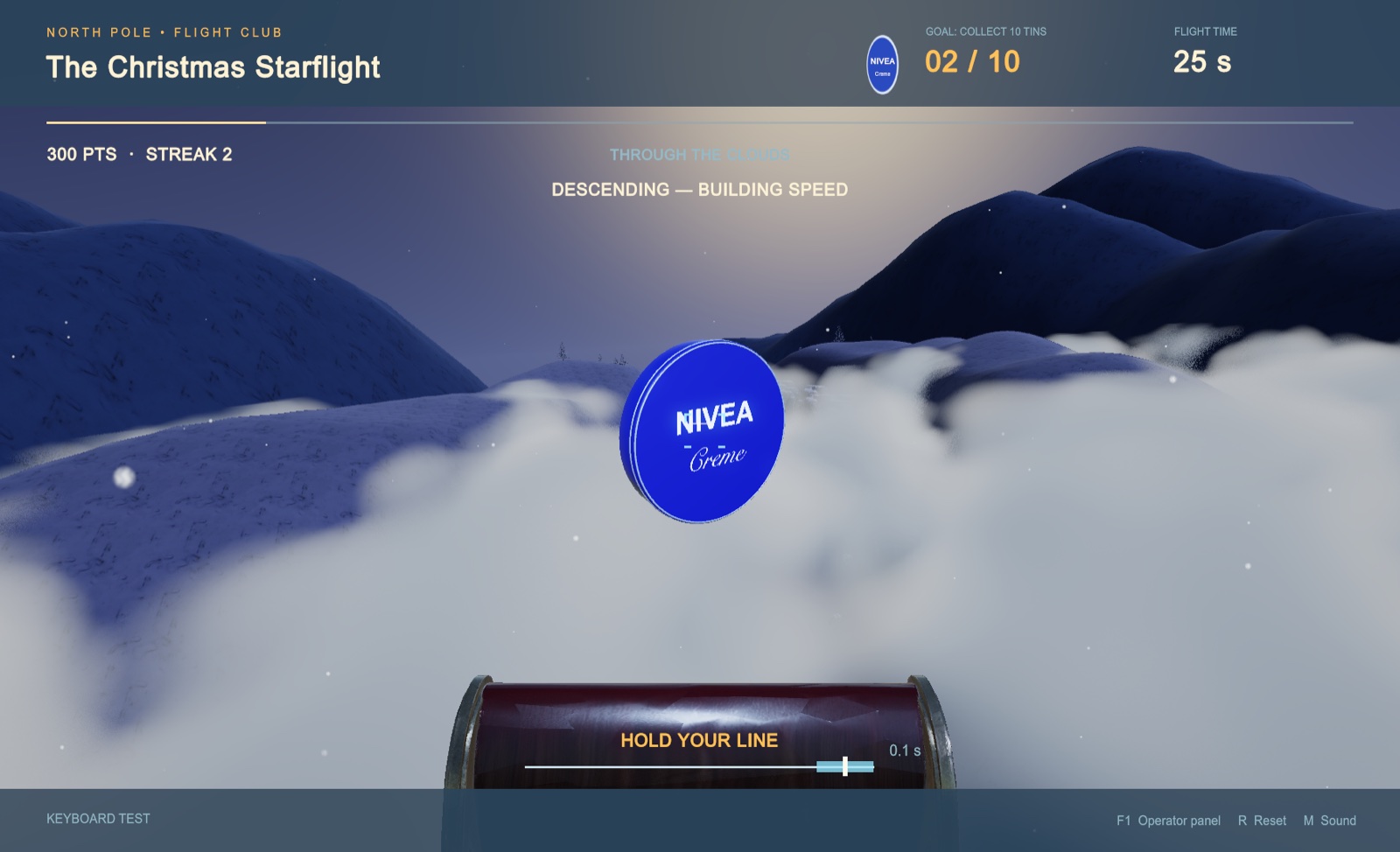
A Christmas game in a shopping mall has to explain itself quickly. People arrive mid-conversation, carrying bags, with different levels of confidence around games. Christmas Starflight starts with an interaction that can be understood by watching: sit down, lean and let the sleigh follow. It connects a small body movement with a much larger world on screen, inviting people to join the journey together.
We designed the experience around a simple festive mission: collect ten NIVEA tins during a 30-second flight to a village Christmas tree. The product becomes something to look for, move towards and celebrate collecting. A short, complete journey gives every round a clear beginning, a shared objective and a recognisable finish.
A route that builds towards celebration
The flight begins among clouds, descends into a canyon, travels through a forest and reaches a village and its Christmas tree. Each environment gives the ride a different sense of scale. Open sky establishes the journey; closer terrain makes the movement easier to read; the village brings the landscape back to a welcoming, human scale.
Day and night settings change the atmosphere of the same route. Snowy terrain, the forest and the village take on a different character as the lighting changes. The arrival at the Christmas tree brings the round to a celebratory close, giving the experience a destination that matters beyond the collection counter.
Lean in and the ride follows
Automatic upper-body tracking turns the player’s lean into steering. The camera can follow one or two participants, without a separate calibration routine for each rider. That makes the transition into play straightforward: enable the camera, grant permission and take your position. The same gesture that moves the sleigh also makes the interaction legible to someone watching.
Keyboard control offers another way to take the flight. Space starts the round, the arrow keys or A and D steer, and R resets. Camera access is optional and requires explicit permission. When enabled, webcam frames are processed locally on the device for movement control. The demo does not upload or record them.
A clear target, a responsive challenge
The ten-tin objective gives the journey an immediate purpose. Collectibles draw attention towards the next movement and connect the brand to an action the player takes. Adaptive tin difficulty adjusts the challenge during play, making responsiveness part of the game design as well as the steering.
With only 30 seconds available, scenery, targets and feedback have to work together. The route keeps moving, the player chooses a line and each tin gives that movement a reason. A repeat flight is an opportunity to try a different approach or experience the other lighting setting.
Two seats, one shared moment
The mall concept places two seats in front of a large screen, with children joining on parents’ laps. A shared lean turns steering into something the riders coordinate together. Their movement gives the people waiting nearby a visible introduction to the game, while the screen carries everyone through the same festive world.
The next stage for this prototype is testing the proposed seating, camera placement and operator flow in the intended space. Welcoming a group, starting their flight and getting ready for the next riders are all part of the experience. Christmas Starflight brings the digital part of that idea into a playable form: a familiar product, a short adventure and a Christmas arrival people can share.
The demo will return after New Year.
The playable experience is temporarily offline.